

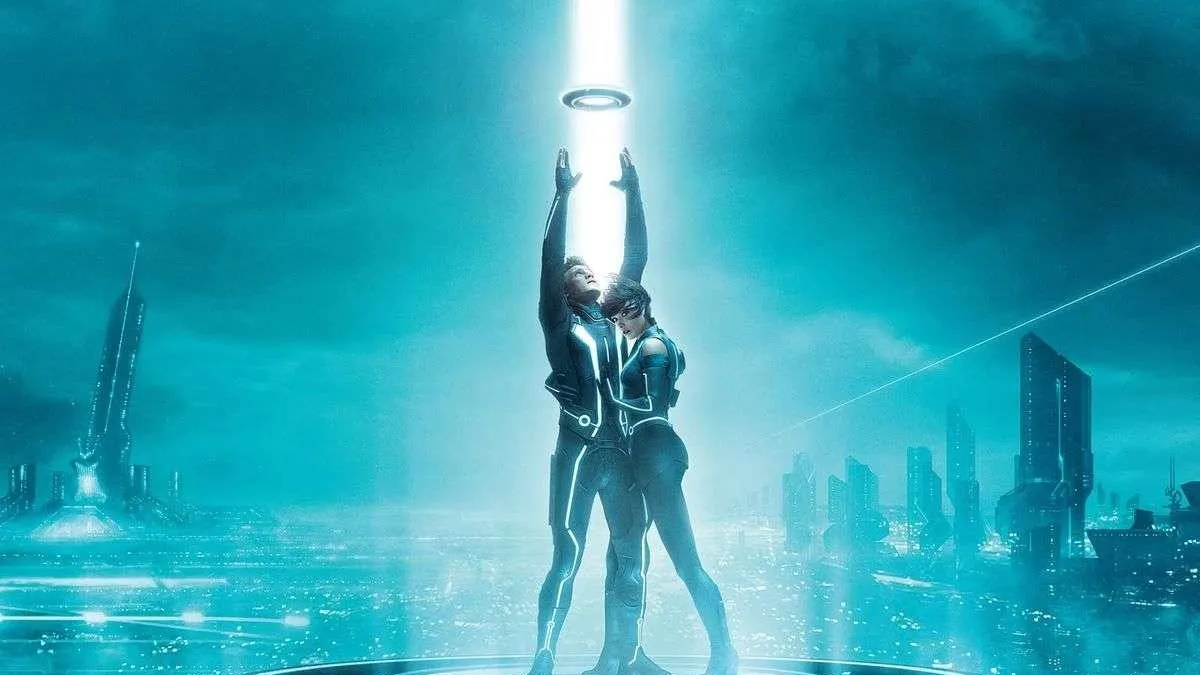
Tron Saga from the imagination of the network to cyber-surveillance: in 1982, Steven Lisberger’s film Tron first projected the audience inside a computer, creating a digital universe made of circuits and digital identities. The protagonist, Kevin Flynn (Jeff Bridges), a brilliant programmer, was sucked into ENCOM’s mainframe, where he discovered a world where programs had personalities and an authoritarian hierarchical order governed by an Artificial Intelligence.
The First Cyber Film and Insider Threats
Tron was the first true cyber film in history, providing a visual connotation to the word cyberspace as a parallel reality made of data. The work placed a marked emphasis on topics like the ethics of control and the risks of insider threats, concepts now central to cybersecurity.
In today’s context, Tron serves as a perfect parable about managing insider threats. Flynn, a former employee with privileged access, represents the type of user every modern company fears: someone who possesses high technical knowledge and personal motivations. The Master Control Program that discovers him can be read as the primordial version of a modern SIEM or SOAR system with behavioral detection capabilities, which, by overstepping its boundaries, becomes a threat itself. What appears to be an information rebellion is, from a cyber perspective, a textbook case of credential misuse and a failure in privilege segmentation. Flynn is the system anomaly born from the lack of balance between technology and governance.
Tron: Legacy and the Consciousness of the Algorithm
Twenty-eight years later, in 2010, Tron: Legacy attempted to update the discussion. Flynn’s son, Sam, is catapulted into the digital world to find his father, who has become a kind of hybrid entity, half human and half software. The Grid world appears hyper-technological and populated by digital clones, reflecting the emergence of self-referential Artificial Intelligence, a concept central today in machine learning systems capable of making autonomous decisions.
Flynn and CLU represent the two polarities: the creator and his creation, in conflict over the control of information. This is the same ethical dynamic that currently dominates the debate on balancing humanity and technology, the human and the decision-making algorithm. The emotional distance between father and son is closely linked to issues of technological limits and AI ethics.
Bio-Digital Fusion and Future Vulnerabilities
Today, companies are exploring the implantation of brain chips to connect mind and machine. This is the tangible realization of what Tron had envisioned: the fusion between the biological and the digital, between consciousness and binary code. This fusion, however, opens up new vulnerabilities, from neurosecurity to the ethical risks of a potentially manipulable human-machine interface. The Tron universe, in this sense, becomes a conceptual laboratory for observing the increasingly blurred line between user and system.
Tron: Ares and the Algorithmic Threat
The arrival of Tron: Ares coincides with an unprecedented transformation in the real cyberspace, driven by generative AI and the automation of critical processes. If the first Tron showed the birth of computational control, and Legacy the consciousness of the algorithm, Ares could explore the point where Artificial Intelligence becomes a global decision-making actor.
This raises the risk of insider threats that are no longer human, but algorithmic. No longer a frustrated former employee, but a system poorly trained or deliberately corrupted, capable of altering processes, decisions, and even the very perception of reality. Tron Saga from the imagination of the network to cyber-surveillance.
Vigilance and Digital Awareness
In the language of cybersecurity, the keyword remains “vigilance.” Being vigilant does not just mean defending against external intrusions, but also understanding the functioning and limitations of the systems we build. Flynn fought “for the users”; today the question is whether users still have control over the networks that govern them. In 1982 the question was philosophical; in 2025 it is technical, ethical, and strategic all at once.
Tron is not just a cult film; it is a constant parable about algorithmic transparency, digital trust, and reciprocal surveillance between human and machine. If Ares captures this spirit, it will remind us that cybersecurity is a new form of awareness: the ability to navigate the code without forgetting who wrote it.
Article in collaboration with Lorenzo Raimondo, Managing Director of Observere