

Edge Computing: Complete Architecture GuideEdge Computing is an open and distributed IT architecture that moves data processing from the centralized cloud towards the periphery (“edge”) of the network, as close as possible to the data source itself. According to official AWS documentation, this paradigm allows information to be processed in real-time where it is generated, drastically reducing the need to send large amounts of raw data to remote data centers. To delve deeper into connected infrastructures, we also recommend consulting our guide on the Internet of Things (IoT).
Key Takeaways
- Proximity: Computation happens near the user or machine (IoT).
- Efficiency: Reduction of latency and bandwidth consumption.
- Decentralization: Less dependence on a single central server.
What is Edge Computing and how is it defined
To fully understand this technology, it is necessary to distinguish it from traditional Cloud Computing. While the Cloud centralizes resources in a few massive data centers, Edge Computing brings computing power, storage, and applications directly to devices (such as smartphones, industrial sensors, or autonomous vehicles) or local servers (Edge Gateways).
According to IBM, this strategy solves latency problems intrinsic to long-distance data transmission. It is not about replacing the cloud, but integrating it: critical data requiring instant responses are handled locally, while only aggregated or less urgent data are sent to the cloud for long-term storage.
How the distributed architecture works
The operation is based on a processing hierarchy. In a traditional model, a sensor detects data and sends it via the internet to a remote server; the server processes it and sends a response. This process can take hundreds of milliseconds.
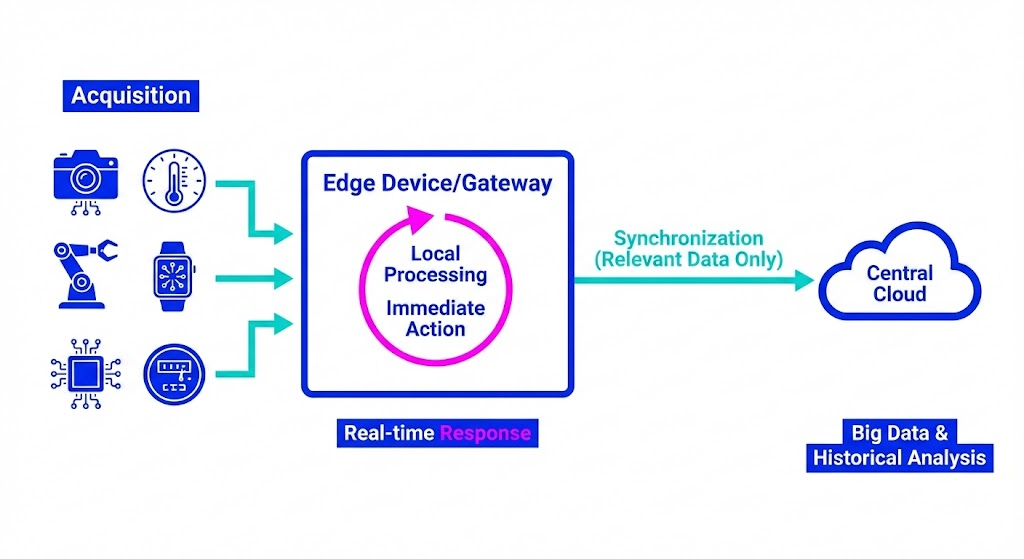
In an Edge architecture, the flow changes:
- Acquisition: Sensors or IoT devices collect data.
- Local Processing: An Edge device (or an on-premise server) immediately analyzes the data using pre-loaded algorithms.
- Immediate Action: If necessary, the system reacts in milliseconds (e.g., stopping machinery in case of failure).
- Synchronization: Only relevant results are sent to the central cloud for historical analysis or Big Data analytics.
The strategic benefits of Edge Computing
Adopting this architecture offers tangible benefits for companies requiring high performance. Technical sources (Microsoft Azure, IEEE) highlight three primary advantages:
- Reduced Latency: Time-sensitive applications (such as autonomous driving or remote surgery) benefit from near-instant response times.
- Bandwidth Optimization: By processing data locally, less information is transmitted across the network, reducing connectivity costs and bottlenecks.
- Security and Privacy: Keeping sensitive data within the local perimeter (“at the edge”) can facilitate compliance with data sovereignty regulations, limiting exposure to the public cloud.