

Digital Twins are dynamic virtual representations of a physical object or system that span its entire lifecycle, updated from real-time data to support decision-making. This technology goes beyond simple static simulation by creating a living bridge between the physical and digital worlds. According to IBM definitions and NASA protocols, a Digital Twin uses IoT sensors to collect data on the state of the real system and applies artificial intelligence algorithms to predict failures or optimize performance.
Key Takeaways
- Dynamic Replica: It is not a static 3D model, but a system that “lives” and changes along with its physical counterpart.
- Data-Driven: It constantly feeds on data from sensors (IoT) installed on the real object.
- Predictive Analysis: It allows testing “what-if” scenarios without risks to the real infrastructure.
What are Digital Twins and how they originated
The concept of “twinning” has origins in aerospace engineering. NASA pioneered this logic during space missions in the 1960s, replicating systems sent into space on the ground (as in the case of Apollo 13) to diagnose problems remotely. Today, Digital Twins have evolved thanks to the convergence of three technologies: increased computing power, pervasive connectivity (5G/IoT), and Big Data analytics.
Unlike a CAD model, which defines the geometry of an object, the Digital Twin understands its behavior. It integrates:
- Historical Data: Past machine performance.
- Real-time Data: Temperature, vibration, pressure.
- Physics Models: The laws of physics governing the object’s operation.
Technical architecture and data flow
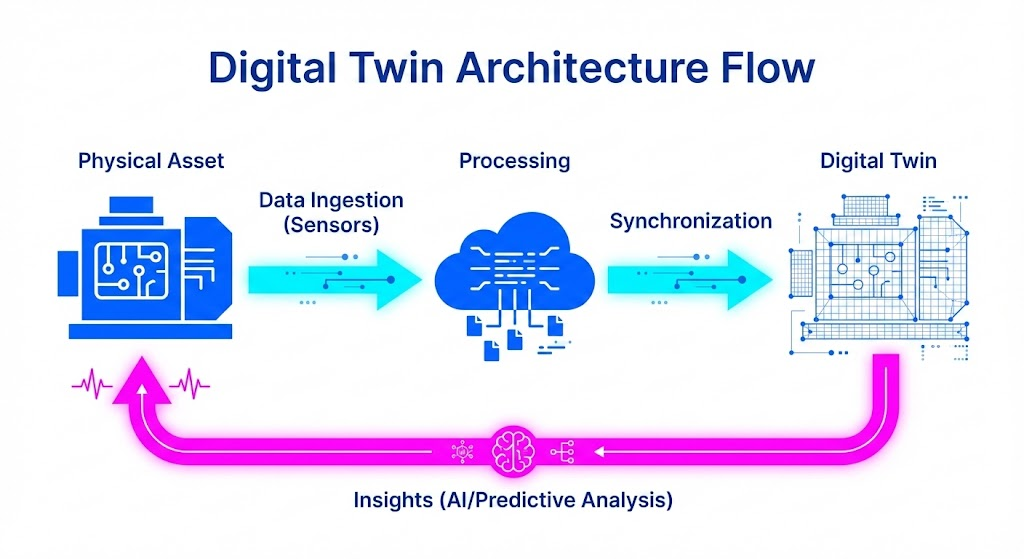
To function correctly, this technology requires robust architecture based on cloud computing (such as Microsoft Azure Digital Twins or AWS IoT TwinMaker). The operational flow follows a precise pattern:
- Data Ingestion: Sensors on the physical asset transmit continuous telemetry.
- Processing: The cloud system aggregates data, cleaning background noise.
- Synchronization: The virtual model is instantly updated to reflect the exact state of the physical asset.
- Insight: Machine Learning algorithms analyze discrepancies between the ideal model and real data to identify anomalies.
Applications of Digital Twins in industry
The adoption of Digital Twins is radically transforming several strategic sectors, enabling a shift from reactive to predictive maintenance.
- Manufacturing (Smart Manufacturing): Siemens and General Electric use this technology to monitor turbines and production lines. If the virtual twin detects simulated overheating, technicians can intervene on the real engine before it breaks.
- Smart Cities: Cities like Singapore possess a digital twin of the entire urban area to simulate traffic, energy consumption, and emergency response.
- Healthcare: The creation of “twins” of human organs is being tested to assess drug efficacy or simulate complex surgeries on a specific virtual patient before operating.
Conclusions and future perspectives
Digital Twin technology represents the backbone of the future Industrial Metaverse. With the evolution of Generative Artificial Intelligence, these systems will become increasingly autonomous, capable not only of flagging a problem but also of implementing automatic corrections on the physical system, definitively closing the loop between bits and atoms.