
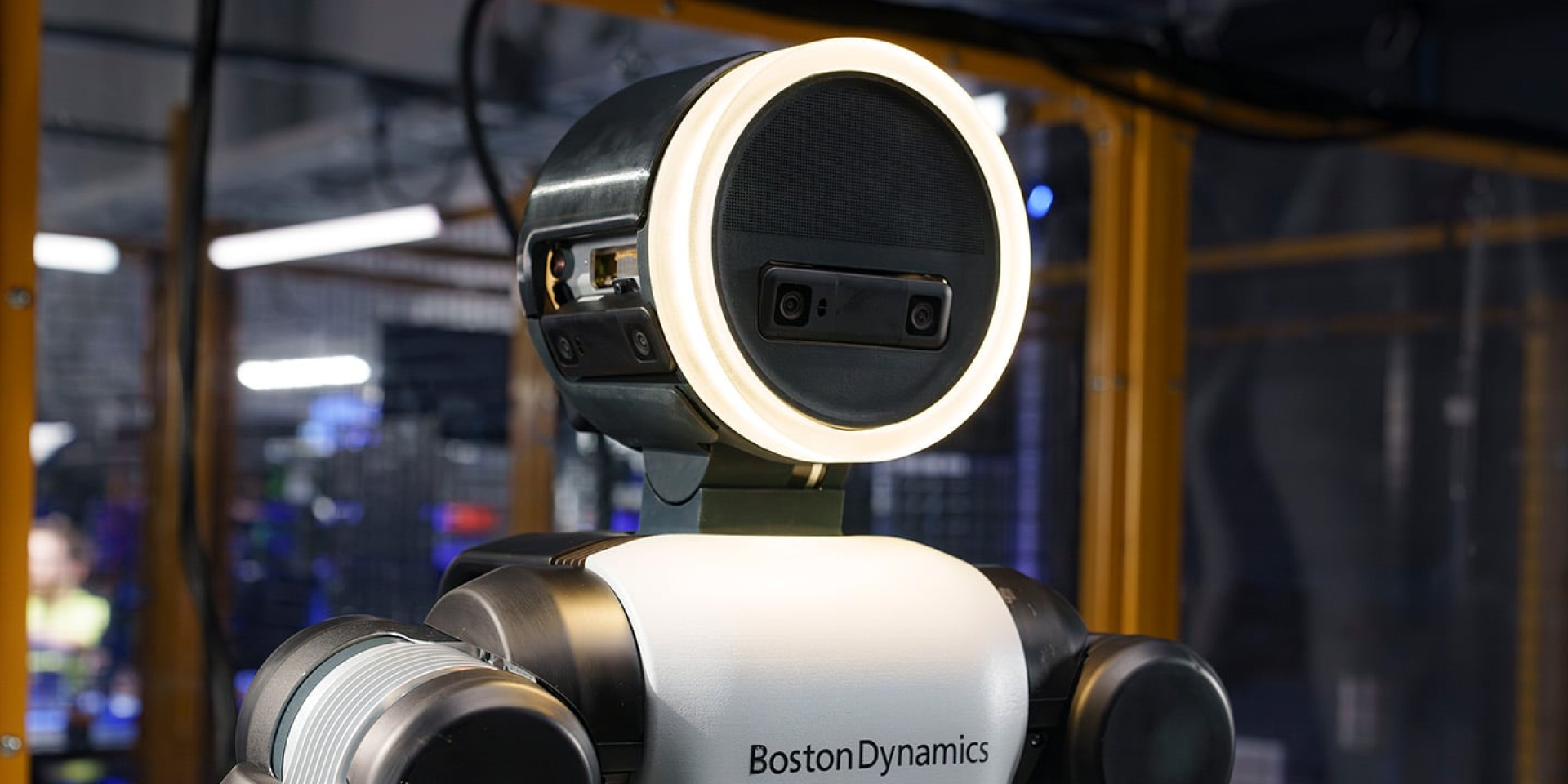
The Robot Atlas is officially ready for mass commercialization and factory entry. At CES 2026 in Las Vegas, Boston Dynamics unveiled the final version of its humanoid, confirming a strategic partnership with Google DeepMind for artificial intelligence and immediate deployment in Hyundai facilities. Moving past the research phase, the new model is designed to operate at scale.
Key Takeaways
- Production: Final commercial version announced at CES 2026.
- AI: Integration of Google Gemini via partnership with Google DeepMind.
- Specs: 56 degrees of freedom, 4-hour runtime, and 3-minute swappable batteries.
New technical specifications of the Robot Atlas
The version presented at CES 2026 marks a clear departure from previous prototypes. The Robot Atlas is now fully electric, eliminating the complex hydraulic systems of the past. This iteration boasts 56 degrees of freedom (DoF), allowing movements superior to human capacity, and new tactile hands for delicate manipulation. A turning point for industrial operability is the power system: the robot guarantees 4 hours of runtime with a “hot-swappable” battery that can be replaced autonomously in just 3 minutes, allowing near-continuous work cycles without long charging times.
The alliance with Google DeepMind
Beyond hardware, the Robot Atlas makes a quantum leap in software thanks to the collaboration with Google DeepMind. The integration of Gemini Robotics models allows the humanoid to understand natural language commands and reason through complex tasks in real-time, surpassing simple execution of pre-programmed scripts. This synergy transforms Atlas from a machine executing movements into a collaborator capable of interpreting the work context.
When we will see the Robot Atlas in factories
Deployment is immediate. Hyundai Motor Group, owner of Boston Dynamics, will be the first customer to integrate the Robot Atlas into its global production lines. The robots will initially be used for logistics and assembly tasks, leveraging their ability to operate in a temperature range of -20°C to 40°C. This move signals Boston Dynamics’ definitive transition from a research lab to a provider of scalable industrial solutions.