

5G Advanced and 6G represent the next evolutionary stages of mobile telecommunications, transforming the network from a simple data channel into a fully integrated intelligent system. While 5G initiated the digitalization of industries, these new iterations—defined respectively by 3GPP Release 18/19 standards and the ITU IMT-2030 framework—introduce environmental sensing capabilities and native artificial intelligence.
Key Takeaways
- 5G Advanced (5.5G): The immediate evolution (2024-2025). It introduces AI into the Radio Access Network (RAN) and drastically improves performance for Extended Reality (XR).
- 6G (IMT-2030): Expected by 2030. It unifies the physical and digital worlds using Terahertz spectrum and ISAC (Integrated Sensing and Communication) technology.
- Business Impact: Enables fully automated factories, mobile holography, and high-precision Digital Twins.
What is the transition to 5G Advanced and 6G
To understand the technological leap, it is necessary to clearly distinguish the two phases, often confused in public debate but well-defined by standardization bodies.
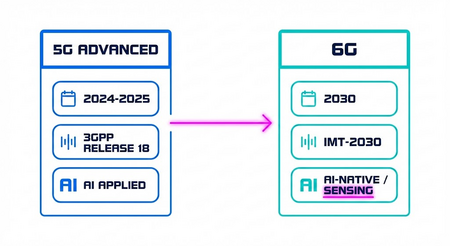
5G Advanced (often marketed as 5.5G) is not a new generation, but a significant update to the existing 5G architecture. Based on 3GPP Release 18, its goal is to maximize spectral efficiency and support ultra-low power IoT devices (“RedCap” or Reduced Capability). It is the necessary bridge to mature the technologies needed in the following decade.
6G, conversely, is a paradigm shift defined by the International Telecommunication Union (ITU-R) in the “IMT-2030 Framework”. It does not merely transmit bits: the 6G network will act as a “sixth sense,” capable of locating objects and mapping physical environments without the need for external sensors, thanks to radio waves themselves.
Technical specifications of 5G Advanced and 6G
The technical differences between the two technologies play out on three main axes: spectrum, intelligence, and architecture.
- Spectrum and Frequencies:
- 5G Advanced optimizes the use of millimeter waves (mmWave) and mid-bands (sub-6GHz) already in use.
- 6G will explore the Sub-THz spectrum (100 GHz to 300 GHz). These frequencies allow for theoretical peak speeds of up to 100-200 Gbps but require new antenna technologies to overcome poor signal propagation.
- Native AI vs. Applied AI:
- In 5G Advanced, Artificial Intelligence is applied on top of the network to optimize traffic.
- In 6G, the architecture will be “AI-Native”: radio interfaces will be designed and managed autonomously by Machine Learning algorithms to adapt in real-time to interference.
- ISAC (Integrated Sensing and Communication):
- This is the “killer application” of 6G. The network uses reflected radio signals to detect the position, shape, and movement of objects with centimeter-level precision, turning every base station into a high-definition radar.
Industrial applications and future scenarios
The evolution of connectivity will unlock use cases currently impossible due to latency and bandwidth limits.
- Industry 4.0 and Robotics: 5G Advanced guarantees the deterministic (stable) latency necessary for collaborative robots (Cobots) in factories. 6G will allow the control of swarms of drones and robots with reaction times under 0.1 milliseconds.
- Metaverse and XR: For a photorealistic and nausea-free Extended Reality (XR) experience, symmetric download and upload speeds are needed. 5G Advanced begins to close the upload gap, while 6G will enable real-time holographic streaming.
- Sustainability (Zero-Energy IoT): One of the promises of 6G is to support IoT devices that do not require batteries, powered by energy harvested from ambient radio waves (Ambient Backscatter Communication).