


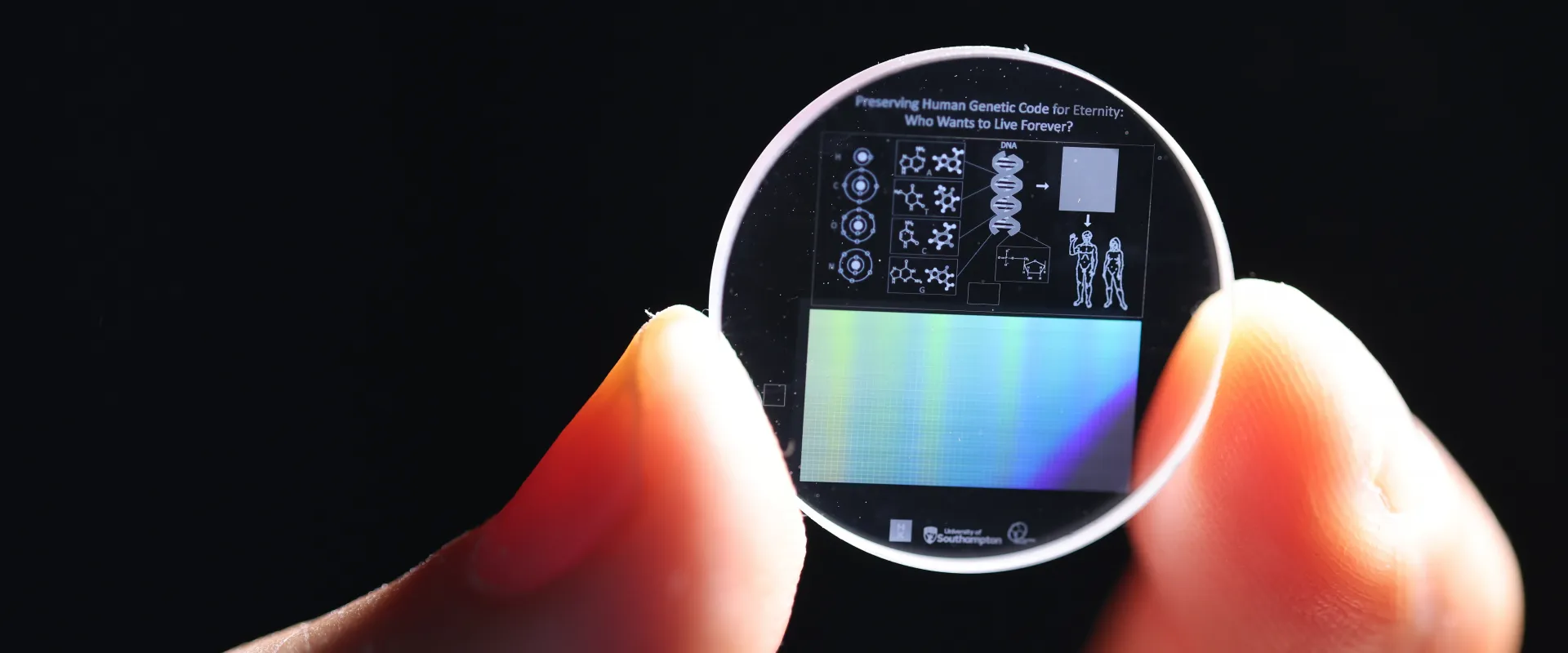
The 5D eternal memory represents a revolution in digital storage, promising to preserve information for 13.8 billion years. Developed by researchers at the University of Southampton’s Optoelectronics Research Centre (ORC), this technology uses nanostructured glass to ensure unprecedented data stability, overcoming the physical limits of traditional magnetic and optical media. [University of Southampton].
Key Takeaways
- Lifespan: 13.8 billion years at room temperature (25°C).
- Capacity: Up to 360 Terabytes on a single glass disc.
- Durability: Data integrity guaranteed up to 1,000°C.
How 5D eternal memory works
The writing process utilizes a femtosecond laser that emits extremely short and intense light pulses. Data is etched onto three layers of nanostructured dots separated by only five micrometers. Unlike standard CDs, 5D eternal memory encodes information in five dimensions: the three spatial coordinates (X, Y, Z) combined with the size and orientation of the nanostructures.
[in-depth analysis of laser technologies].
Extreme resistance and storage capacity
The choice of silica glass is intentional. This material provides exceptional thermal resistance, allowing the medium to remain intact at temperatures up to 1,000°C. With a storage density that allows 360 TB on a small disc, this technology solves the “digital decay” issue affecting current hard drives and servers.
The future of data with 5D eternal memory
The potential of 5D eternal memory has already been tested by preserving fundamental human documents, such as the Universal Declaration of Human Rights and the King James Bible. This innovation aims to be the ultimate standard for national archives, museums, and scientific institutions needing to preserve knowledge for future civilizations.