

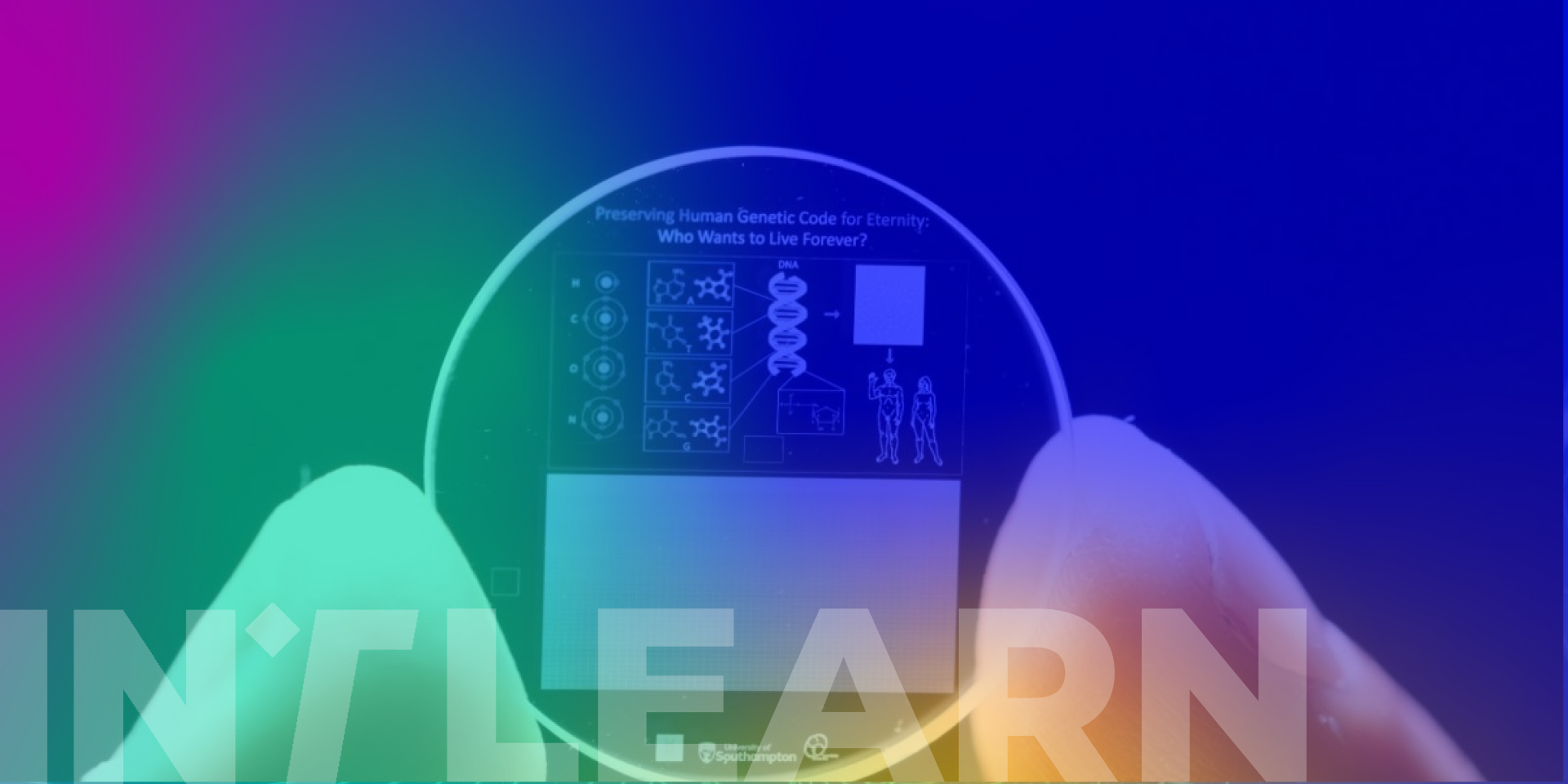
5D laser technology has reached a historic milestone, allowing the University of Southampton to archive the entire human genome on a practically indestructible memory crystal. Developed by researchers at the Optoelectronics Research Centre (ORC), this innovation promises to preserve the code of human life for billions of years, potentially surviving our species itself. Using ultrafast lasers to inscribe data into silica glass, the team led by Professor Peter Kazansky has created what has been nicknamed the “Superman memory crystal”.
Key Takeaways
- The entire human genome has been inscribed on a crystal the size of a coin.
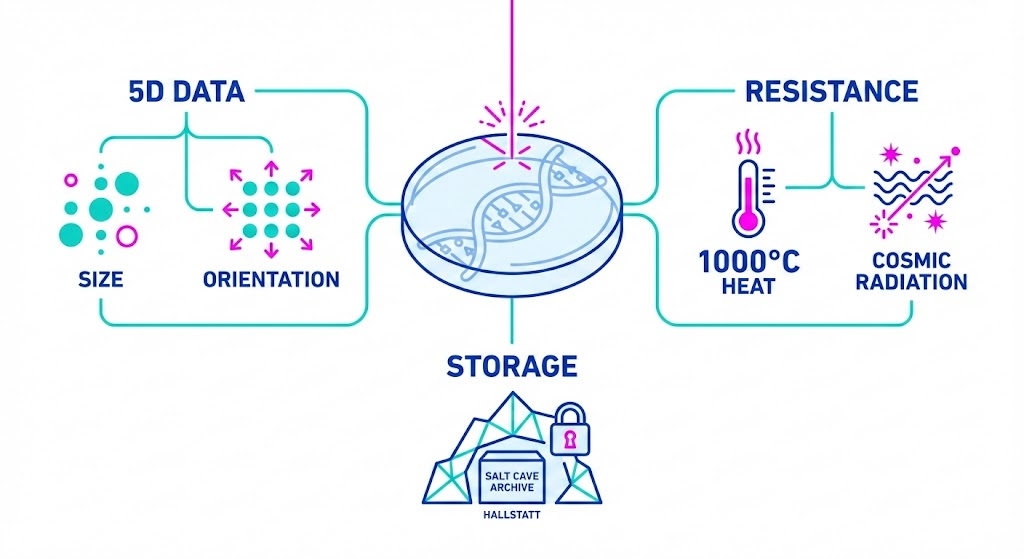
- The medium withstands 1000°C, cosmic radiation, and extreme impact forces.
- The data is preserved in the “Memory of Mankind” archive in Austria.
How 5D laser technology works exactly
Unlike traditional media that degrade over time, this system uses femtosecond lasers (ultra-short light pulses) to write data into the void structure of glass. The term “5D laser technology” derives from the encoding method: in addition to the three standard spatial dimensions, information is stored through two additional optical dimensions, namely the size and orientation of the nanostructures created. This complexity allows for unprecedented data density, enabling a single crystal to host up to 360 Terabytes of information without loss of quality.
An indestructible archive in the Hallstatt cave
Durability is the key factor of this discovery. The crystals produced can withstand temperatures up to 1000°C, impact forces equal to 10 tons per cm², and prolonged exposure to cosmic radiation. To ensure maximum safety, the first crystal containing the human genome was transported to the Memory of Mankind archive. This is a time capsule located inside a salt cave in Hallstatt, Austria, designed to protect human knowledge from potential global catastrophes or the simple passage of millennia.
The future potential of 5D laser technology
The application of this medium goes beyond simple digital archiving. On the surface of the crystal, a visual key has been inscribed illustrating the double helix structure of DNA and the fundamental molecular elements (hydrogen, oxygen, carbon, nitrogen). This serves as a guide for future intelligences or civilizations that might find it, allowing them to decode and potentially use the data to restore living organisms. 5D laser technology thus becomes the definitive candidate for creating a permanent repository of the genomes of plants, animals, and humans threatened with extinction.